

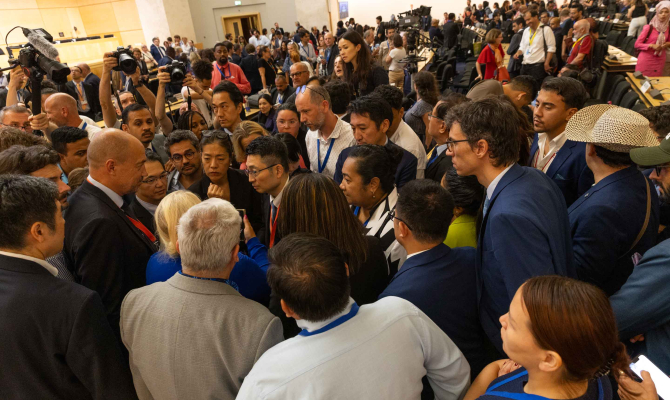
The world came to Geneva with hope. Eleven days of tense, high-stakes negotiations — hailed as the most consequential environmental talks since the Paris Climate Accord — were meant to deliver a historic treaty to end plastic pollution. But, as the sun rose over Lake Geneva on Friday morning, delegates left the UN complex with no agreement, disappointed and with the heavy reality that the plastic crisis rages on unchecked.
After two and a half years of negotiations, the second part of the fifth session of the Intergovernmental Negotiating Committee (INC-5.2) was supposed to conclude on Thursday evening with a breakthrough: the world’s first legally binding instrument to tackle plastic pollution. Instead, it spiralled into a marathon of backroom consultations, regional consultations and small-group negotiations.
Over 184 countries spent the final hours negotiating the Chair’s Draft Text Proposal, first tabled by INC Chair Ambassador Luis Vayas Valdivieso of Ecuador on Wednesday, 13 August. After an eight-hour delay, the plenary convened at 11.36 pm and was adjourned a minute later, the INC Chair informing delegates that consultations were ongoing. A revised iteration of the draft text was released at 2.00 am, described by the Chair as an effort to identify “balanced solutions” and “landing zones” to build consensus.
The updated draft text proposal acknowledged that current global levels of plastic production and consumption are “unsustainable,” exceed existing waste management capacities, and are projected to increase further, trends that “necessitate a coordinated global response.” Yet, it stopped short of committing to a binding cap on global plastic production.
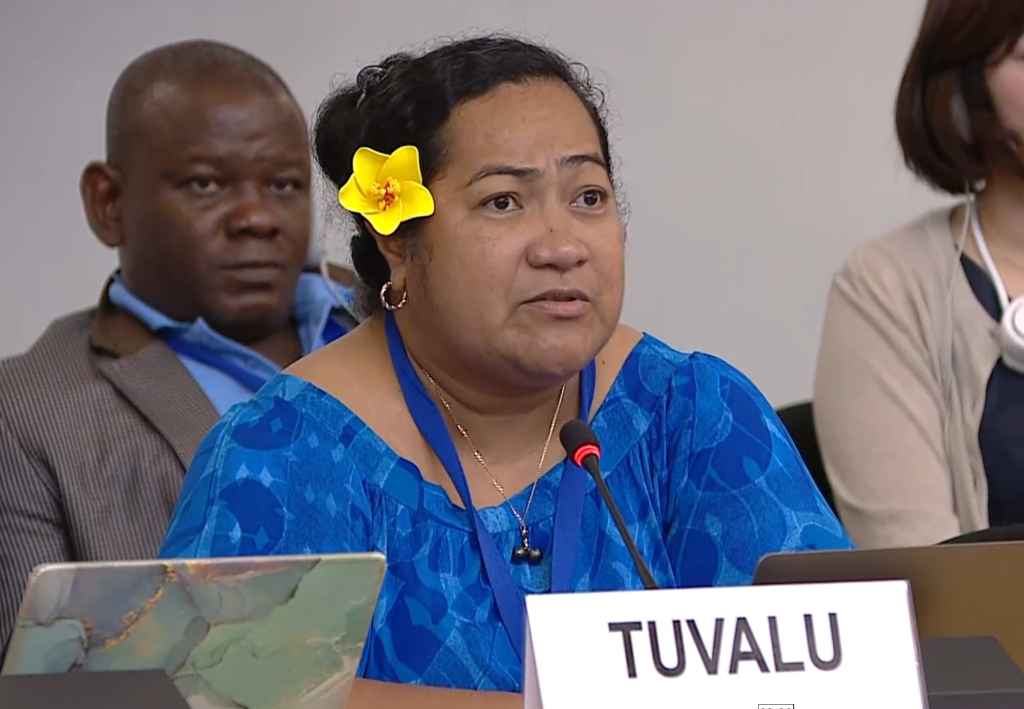
“We attended these negotiations hoping today we would reach a historic agreement to begin the process to end plastic pollution, especially in our marine environments,” said Ms. Pepetua Latasi, Chair of Pacific Small Islands Developing States (PSIDS) and Tuvalu’s Permanent Secretary for the Ministry of Home Affairs, Climate Change and Environment.
“Unfortunately, despite our best efforts, no agreement has been reached and we leave empty-handed. For our islands, this means millions of tonnes of plastic waste will continue to be dumped in our oceans, affecting our ecosystems, food security, livelihoods, and cultures.”
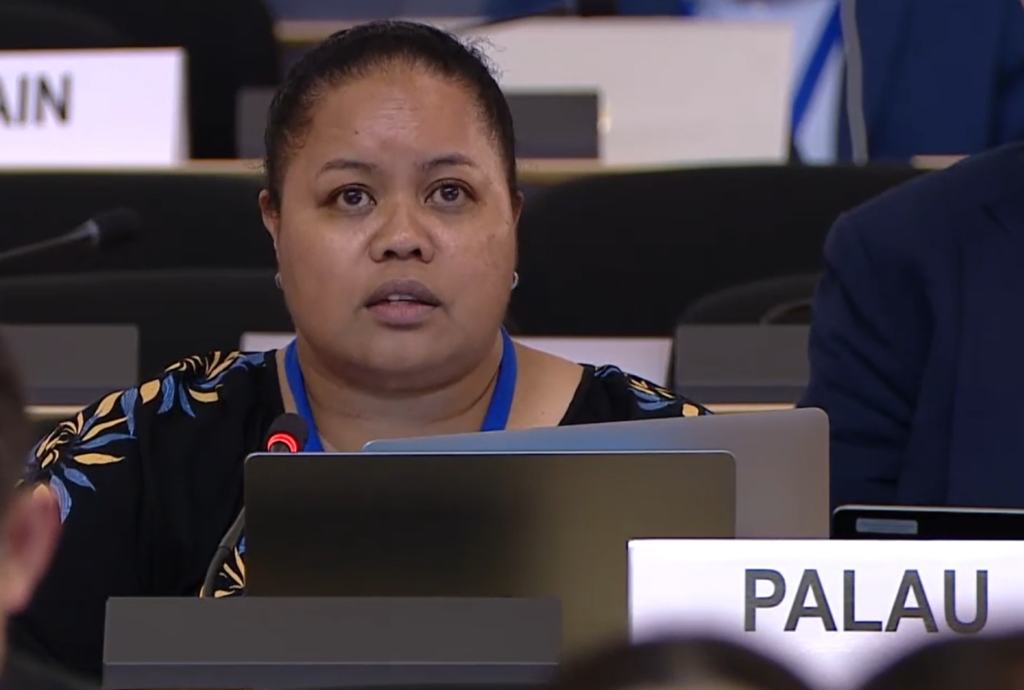
Palau, speaking as Chair of the Alliance of Small Island States (AOSIS) on behalf of 39 vulnerable nations, reminded the INC of the trust and transparency needed to bridge divides.
“We were clear in our asks — timely, clear instructions, the empowerment of co-chairs, more informal meetings, and consistent modes of work that could help us deliver the mandate we were given,” said Ms. Gwen Sisior, the Principal Advisor of AOSIS. We reiterate those asks and emphasise the strong need for transparency, cooperation, and trust in the process. We saw glimpses of flexibility and progress, but in the end, the clock got the best of us.”
Ms. Inger Andersen, the Executive Director of the United Nations Environment Programme, while acknowledging the challenges and disappointment, highlighted that significant progress was made.
“I know this will not be the ending delegates had hoped for, and nor the ending UNEP worked for. Expectations were high for this meeting, and I know that our collective efforts will not stop here,” she said. “It is clear that divides remain regarding core issues on production, plastic products, finance and voting. The world needs more time to come to full agreement on these critical issues.”
The Secretariat of the Pacific Regional Environment Programme (SPREP) worked closely with Tuvalu as Chair of PSIDS and Palau as Chair of AOSIS, to coordinate and strategise throughout long days and nights of negotiation.
“The Pacific knows all too well that plastic pollution respects no borders. It is a transboundary crisis. While our region bears the brunt, its impacts ripple across oceans, continents, and generations,” said Mr. Anthony Talouli, Director of Waste Management and Pollution Control at SPREP.
“Our work is not done here. We remain committed to a strong, ambitious, binding treaty. The future of our oceans, our communities, and our shared planet hangs in the balance. We cannot afford to fail.”
The INC Chair adjourned the session to a later date and location yet to be announced.
The second part of the fifth session of the Intergovernmental Negotiating Committee to develop an international legally binding instrument on plastic pollution, including in the marine environment (INC-5.2), is taking place from 5 to 14 August 2025 at the Palais des Nations in Geneva, Switzerland.
The Pacific Islands are represented by the Cook Islands, Federated States of Micronesia, Fiji, Kiribati, Marshall Islands, Nauru, Niue, Palau, Papua New Guinea, Samoa, Solomon Islands, Tonga, Tuvalu and Vanuatu through the support of the Government of Australia through the Pacific Ocean Litter Project (POLP), and the United Nations.
They are supported by the Secretariat of the Pacific Regional Environment Programme (SPREP), working with partners from the Pacific Islands Forum Secretariat (PIFS), Office of the Pacific Ocean Commissioner (OPOC), The Pacific Community (SPC), Forum Fisheries Agency (FFA), Environmental Investigation Agency (EIA), Centre for International Environmental Law (CIEL), University of Wollongong, WWF and Massey University.
Photo: Kiara Worth_IISD/ENB