

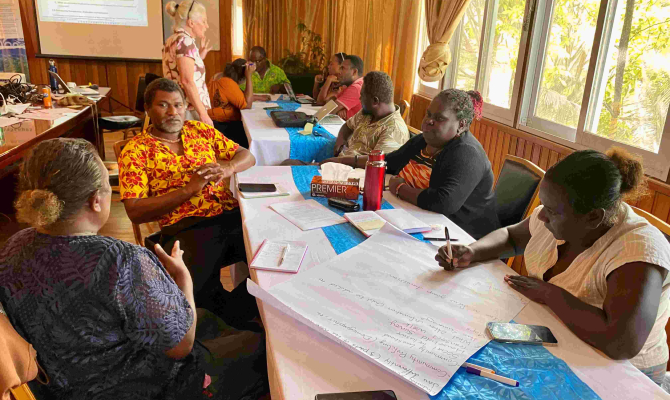
Human Rights-Based Approach (HRBA) and Gender Equality, Disability, and Social Inclusion (GEDSI) mainstreaming is essential to addressing the complexities of biodiversity coupled with challenges posed by climate change, recognising that these challenges have unequal impacts on people living in vulnerable situation.
A 4-day capacity building workshop on integrating Human Rights-Based Approach (HRBA) and Gender Equality, Disability, and Social Inclusion (GEDSI) biodiversity conservation and management was concluded last week in Honiara, organised and facilitated by the Pacific BioScapes Programme, a European Union (EU) funded action, managed and implemented by the Secretariat of the Pacific Regional Environment Programme (SPREP).
The workshop was attended by 22 people participants from a range of institutions including government officers from the Ministry of Environment, Climate Change, Disaster Management and Meteorology (MECDM), the Ministry of Fisheries and Marine Resources (MFMR), Ministry of Forestry and Research (MFR), the Central Islands Province Government, the Pacific BioScapes Programme implementing partner the Wildlife Conservation Society (WCS) and related conservation and biodiversity projects implemented by the government and other partners.
The workshop aimed at strengthening national capacity in integrating HRBA and GEDSI into biodiversity conservation. It is an outcome of a Gender and HRBA assessment and a Capacity Needs Assessment conducted in 2024 and 2025 respectively, by the Pacific BioScapes Programme, with stakeholders namely WCS, MECDM and MFRM.
During the opening of the workshop, Mr. Josef Hurutarau, Director of the Environment and Conservation Division, MECDM, reminded the participants that “resource management and conservation is not only about protecting ecosystems, but it is also about respecting our people’s rights, values, culture, stories and voices. And ensuring that men, women, youth, persons with disabilities, and all community members participate and benefit from our collective efforts.”
Participants found the workshop insightful, practical and enriching in integrating GEDSI and HRAB in their current work.
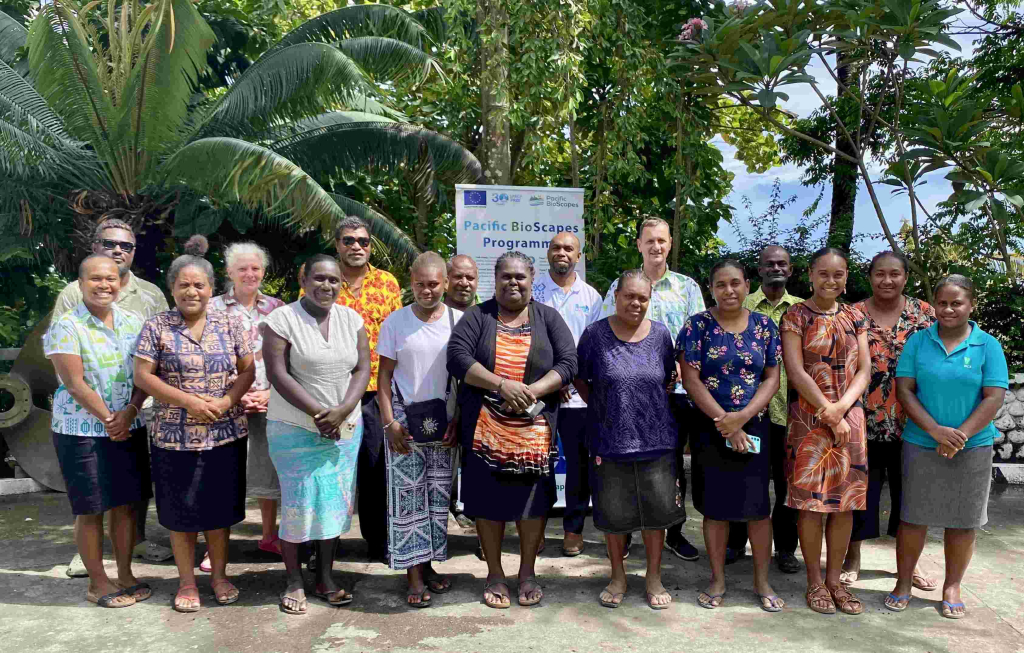
“The workshop was very useful. The key take away part is the importance of being social inclusive. Many times, this has always been overlooked in terms addressing Water, Sanitation and Hygiene (WASH) in our work,” Mr Charles Kaula, Environmental Health Officer, Central Province, RWASH, Central Provincial Government.
Reflecting on his work, Mr. Kaula further commented that “the design part of the WASH systems needs to be inclusive of people with disability and the gender especially for girls so that the facilities suite them.”
“What I want to do it differently after attending this training is applying social inclusion in any of our activity from the planning stage to the construction stage of any WASH projects.”
The workshop covered 11 topics including GEDSI and HRBA analysis, stakeholder engagement, Child Safeguarding, Monitoring, Evaluation and Learning, Free, Prior and Informed Consent, Safety Planning, Grievance Redress Mechanism, Local Resource Management Committees, Working with People with Disabilities and GEDSI Action. It utilised experiential learning with Solomon Islands and biodiversity conservation and management examples across all areas to maximise engagement and to minimise transactional one-way lecture type training.
"Our aim for this workshop was to move beyond theory and give participants practical, actionable tools they can apply to help identify and solve GEDSI challenges in their projects," said Kim Robertson, SPREP’s Gender Adviser.
“We all learned from each other and the participants identified practical and creative solutions to some of their GEDSI challenges.
This capacity building initiative is supported by the Secretariat of the Pacific Regional Environment Programme (SPREP) through the Pacific BioScapes Programme, funded by the European Union The Solomon Islands Project, “Central Solomon Islands Seascape” is implemented by SPREP and the Wildlife Conservation Society (WCS), in collaboration with the Central Provincial Government, Ministry of Environment, Climate Change, Disaster Management, and Meteorology (MECDM), Ministry of Fisheries and Marine Resources (MFMR)’s Community Based Resource Management (CBRM) Unit - thank you to our partners for continued support and collaboration.
For more information, please see the new publication: Mainstreaming human rights, gender equality, disability and social inclusion in the Pacific BioScapes programme: abstracts, guidelines, tools and references