


25 February 2026, Apia, Samoa - For Samoa, invasive species are not an isolated environmental issue, they are a direct threat to the nation’s biodiversity, food security, agricultural systems, cultural heritage and economic stability.
Every year, invasive plants, insects, animals and pathogens erode the resilience of ecosystems and place an increasing strain on national biosecurity systems. Past incursions have shown that once an invasive species becomes established, the cost of control increase rapidly making prevention and early response essential.
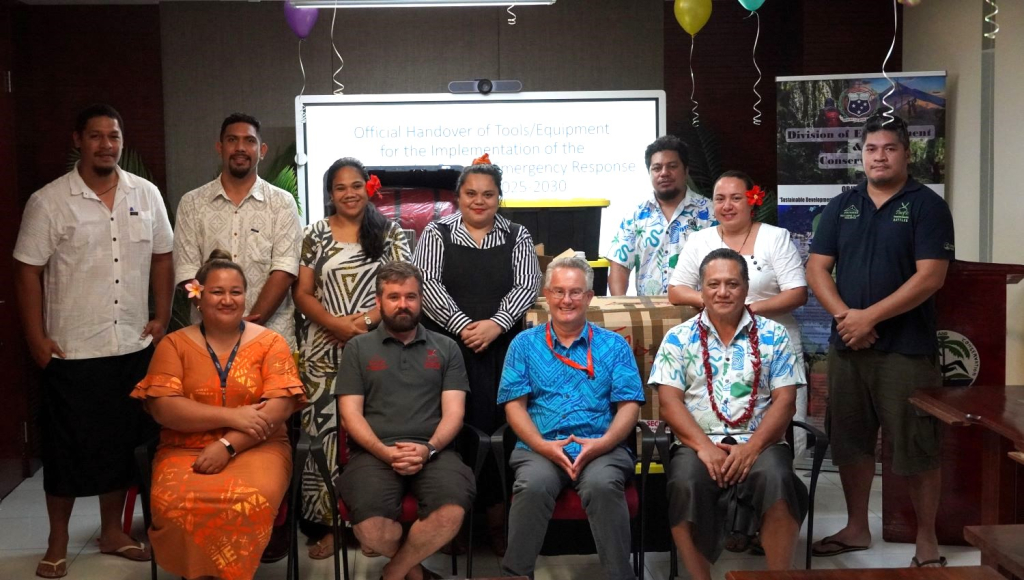
Representatives from the Division of Environment and Conservation (DEC), Ministry of Natural Resources and Environment (MNRE), the Secretariat of the Pacific Regional Environment Programme (SPREP) and the British High Commission gathered for an important milestone in Samoa’s ongoing fight against invasive species.
The event marked the official handover of vital tools and equipment procured under the SPREP led Pacific Regional Invasives Species Management Support Service’s (PRISMSS) - Restoring Island Resilience (RIR) project. Under the RIR-Protect Our Islands (POI) programme, these equipment will directly support the implementation of the Samoa Invasive Species Emergency Response Plan (SISERP) 2025–2030.
The RIR project is funded by the New Zealand Ministry of Foreign Affairs and Trade and the United Kingdom International Development, which enables PRISMSS to help Pacific nations build resilience against the growing challenges of climate change and invasive species.
The SISERP is Samoa’s national blueprint for rapid, coordinated action to prevent, detect and respond to invasive species arrivals. It strengthens national preparedness, safeguards biodiversity and livelihoods and aligns Samoa with regional and international biosecurity and conservation commitments. It is central to Samoa’s environmental resilience and long‑term sustainability.
It forms part of Samoa’s broader invasive species management system, alongside its updated National Invasive Species Strategy and Action Plan (NISSAP) 2025–2030. The SISERP outlines clear roles, responsibilities, procedures and coordination mechanisms for government agencies particularly MNRE and the Ministry of Agriculture and Fisheries (MAF) to ensure Samoa can respond quickly before invasive species become established and cause widespread damage.
The tools and equipment handover demonstrates Samoa’s commitment to preparedness and resilience and reinforces collaboration between MNRE, Ministry of Agriculture and Fisheries and regional partners highlighting the value of international cooperation in safeguarding Pacific islands from shared threats. As Samoa finalises the SISERP through the GEF-7 Invasive Alien Species Project, the tools handed over enables the country is well-positioned to immediately operationalise and test its response capabilities.
Mr Suemalo Tumutalie Foloiga, Assistant Chief Executive Officer, DEC, MNRE commented during the handover ceremony that, “today’s handover of SISERP equipment marks a major step forward in strengthening Samoa’s frontline defences against invasive species.
“With support from SPREP, PRISMSS and our development partners, we are moving from planning to readiness and action, equipping our biosecurity teams with the tools they need to detect, respond, and contain threats before they become national emergencies.”
The Assistant Chief Executive Officer emphasised that SISERP, once fully operationalised, will act as Samoa’s national frontline defence, enabling rapid responses to new incursions through robust surveillance, early detection, delimiting surveys, and coordinated action.
“By receiving this equipment, Samoa sends a clear message that safeguarding our environment is not optional, it is essential for protecting our people, our culture, our biodiversity and the future of our islands. Preparedness today will save a resilient Samoa from far greater costs tomorrow.”
Mr Daniel Garlick, Deputy British High Commissioner commented that, “this equipment handover represents a significant step in boosting Samoa’s capacity to detect and respond to invasive species threats.”
“The UK is pleased to support initiatives that enhance biosecurity, strengthen community resilience and protect the ecosystems that Pacific communities depend on and we remain committed to working alongside Samoa and regional partners to deliver solutions that are sustainable, evidence-based and locally driven.”

SPREP Invasive Species Adviser, Mr David Moverley shared that, “the journey toward today’s handover began in early 2025 after consultations between SPREP-PRISMSS and MNRE-DEC.”
“Recognising Samoa’s need for updated and fit-for-purpose response gear, the PRISMSS RIR project committed to procuring all tools and equipment listed under the SISERP 2025–2030.”
“Procurement has now been completed and the equipment meticulously selected to match Samoa’s emergency response requirements and is ready to be deployed jointly by MAF-Biosecurity and MNRE-DEC.”
The PRISMSS Manager, Mr Dominic Sadler, shared that, “public vigilance, community engagement, and timely reporting remain essential pillars of successful early detection but while tools can strengthen preparedness it is the communities who provide the guardianship.”
“Our PRISMSS POI programme reflects this understanding as it is designed to support countries not only through equipment and technical expertise but also through strengthened partnerships, inclusive planning and coordinated national responses.”
PRISMSS operates as a regional Centre of Excellence, connecting Pacific countries to world-leading invasive species management knowledge, training, and technical support. With continued coordination PRISMSS, through its six specialised service delivery programmes will strengthen its assistance to Pacific island countries in their ongoing battle against invasive species protecting islands, its ecosystems, and making the Pacific resilient.
About PRISMSS: The Pacific Regional Invasive Species Management Support Service (PRISMSS) is a service designed to facilitate the scaling up of operational management of invasive species in the Pacific. The SPREP Center of Excellence, PRISMSS brings together experts to provide support within the Pacific region with a focus on protection of indigenous biodiversity and ecosystem function. As a service provider, PRISMSS provides a comprehensive suite of support services in a cohesive, effective, efficient, and accessible manner to Pacific Island countries and territories.
Restoring Island Resilience (RIR): The PRISMSS - Restoring Island Resilience (RIR) is a New Zealand-PRISMSS collaboration project that aims to improve Pacific Island Countries and territories livelihoods and resilience to climate change by reducing the impact of invasive species on natural and agricultural ecosystems through the six PRISMSS programmes.
PRISMSS Powered by: New Zealand Foreign Affairs & Trade, United Kingdom International Development, GEF, United Nations Environment Programme & SPREP.
PRISMSS Partners: Bioeconomy Science Institute, Birdlife International, Earth Sciences New Zealand, New Zealand Department of Conservation, Island Conservation, the Pacific Community and SPREP.
PRISMSS Programmes: Protect Our Islands (POI), Predator Free Pacific (PFP), War On Weeds (WOWs), Natural Enemies Natural Solutions (NENS), Resilient Ecosystems Resilient Communities (RERC) and Protect Our Marine Areas (POMA).
For additional information please contact Mr Dominic Sadler, PRISMSS Manager on dominics@sprep.org or Mr Nitish Narayan, PRISMSS Communications & Liaison Officer on nitishn@sprep.org