

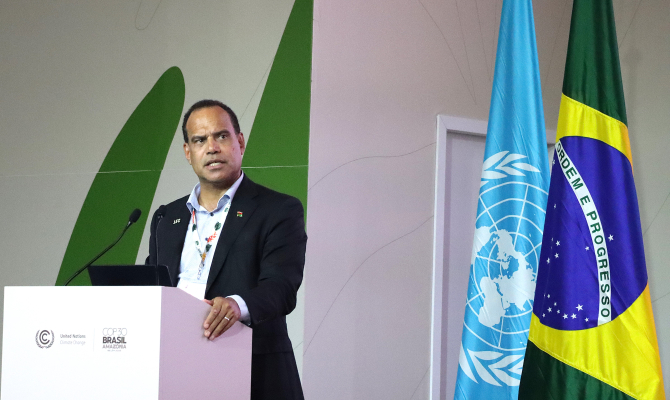
19 November 2025, Belem - Vanuatu's leadership in seeking an advisory opinion from the International Court of Justice (ICJ) on climate change, which resulted in a landmark ruling that countries have an obligation to align their policies with the Paris Agreement target to limit emissions to 1.5C, continues to take centre stage at COP30 in Belem, Brazil.
And as climate change negotiators and officials begin to burn the midnight oil in different negotiation tracks, where the ICJ opinion is being discussed, dissected and disputed, Vanuatu’s Minister of Climate Change, Hon. Ralph Regenvanu, has reminded that the advisory opinion merely reaffirms what Pacific countries have insisted on for years – that all states have clear legal obligations to protect the climate system.
“My country remains among the most climate-vulnerable nations on earth. For us, climate impacts are not just environmental shocks; they are economic shocks of an existential scale,” said Minister Regenvanu.
During the past 10 years , extreme weather events have inflicted damages equivalent to well over half of Vanuatu’s GDP, repeatedly setting back hard-won development gains and locking the nation in a cycle of perpetual recovery. “The climate crisis is undermining our very ability to create a self-determined future for ourselves.”
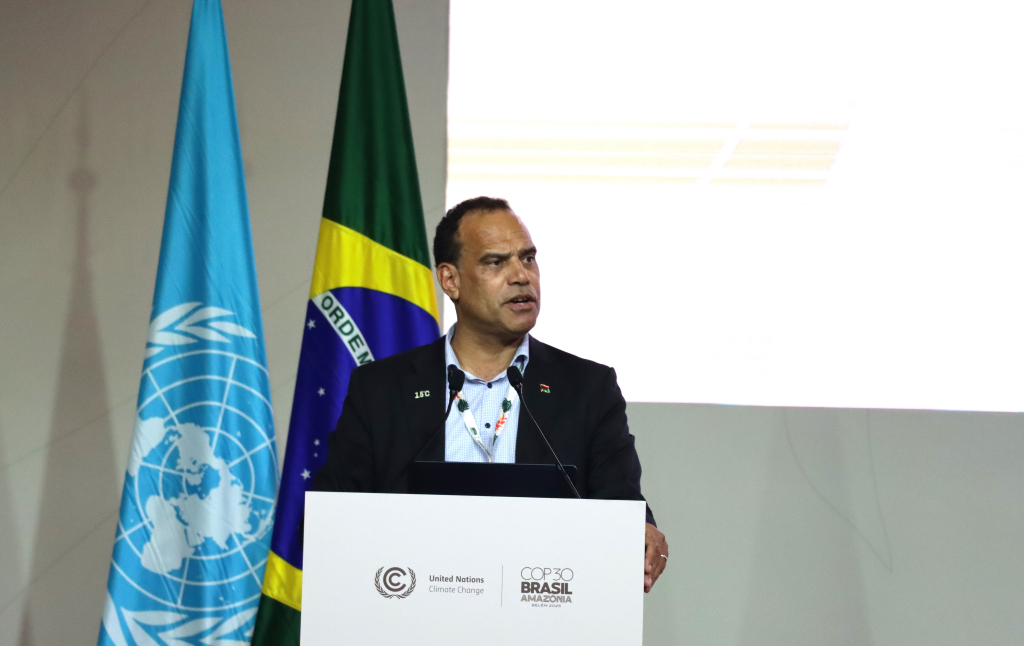
Hon. Regenvanu amplified Vanuatu’s voice during the High-Level Segment of COP30 in Brazil, where he was amongst Pacific leaders calling for urgent climate action and increased ambition to address the impacts of the climate crisis. The ICJ opinion is a subject of much discussion in the negotiation rooms and in the hallways of COP30, during the remaining days of the conference. For Hon. Regenvanu and Vanuatu, the opinion is validation of sorts.
“This year, the International Court of Justice reaffirmed what small island developing states have long insisted: that states have clear legal obligations to protect the climate system, guided by the findings of the IPCC as the best available science, and the principles of equity and intergenerational justice,” he said.
“The ICJ opinion echoes the IPCC’s warnings, reaffirming that 1.5° is the limit for survival in countries like Vanuatu.”
On July 23, 2025, the ICJ determined that the 1.5°C temperature target is legally binding under the Paris Agreement and that all states, in particular the largest emitters, must take ambitious mitigation measures in line with the best available science. The Court also rejected arguments from some high-emitting states that climate treaties are the only applicable law to the climate crisis, excluding broader international law.
At COP30, dubbed an implementation COP, Hon. Regenvanu reminded that the timeframe for addressing 1.5° is urgent, and the window for action to keep 1.5° within reach is closing.
“We need all major emitters to align their NDCs with a 1.5° compatible trajectory, and to act with the urgency that the science - and now international law - demands. Climate ambition must be matched with climate finance that is additional to official development assistance, accessible, grant-based, predictable, and equitable,” he said.
“Climate finance is not charity. It is a legal and moral obligation, grounded in responsibility and capacity, as affirmed by Article 9.1 of the Paris Agreement, and further echoed in the ICJ opinion.”
Vanuatu welcomes the operationalisation of the Loss and Damage Fund, but the Pacific nation says its success will depend on real resourcing and rapid disbursement.
“For Vanuatu, loss and damage is already eroding livelihoods, cultures and territory. We stand firmly with AOSIS in previously made statements: that the most vulnerable must be prioritised due to our special circumstances.”
Adaptation for Vanuatu is not optional, the Minister pointed out. “We need robust support for climate-resilient infrastructure, early warning systems, and sector-wide resilience, from food systems to health and education.”
COP30 is scheduled to end on Friday. As the meeting approaches the mid-week point of the second week, the COP Presidency remains occupied in consultations over “the big four” issues: nationally determined contributions, biennial transparency reports, developed countries’ finance provision (under Paris Agreement Article 9.1), and unilateral trade-restrictive measures.
In a “Mutirão mobilization for the Belém package,” the Presidency projected a list of close to twenty items that may be considered important for a balanced outcome from COP 30.
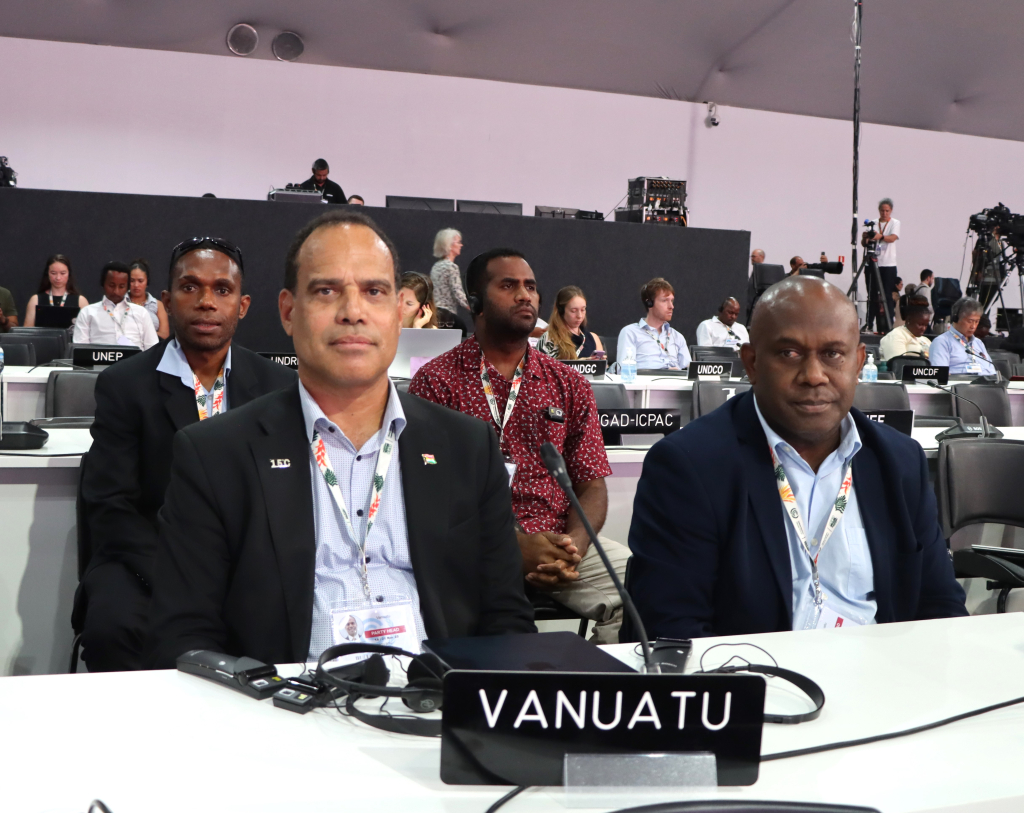
At the High Level Segment, Hon. Regenvanu urged all delegates to rise to the challenge.
“The climate crisis does not respect borders, and neither should our solutions. We call on all Parties, developed and developing, large and small, to rise to the challenge in the true spirit of multilateralism, solidarity, and shared responsibility,” he said.
“Vanuatu stands ready to cooperate, to lead, and to partner with all Parties in delivering climate action that is ambitious, just, and science-aligned. Together, we can and must deliver a future where no nation is left behind.”
The 30th Conference of the Parties to the UN Framework Convention on Climate Change (UNFCCC) is taking place from 10-21 November 2025 in Belem, Brazil.
It is being attended by Pacific leaders and their delegations, who are advocating for the survival of Pacific communities who continue to be at the forefront of climate change impacts.
Support for our Pacific Islands at COP30 from members of the Council of Regional Organisations of the Pacific (CROP) is through the One CROP mechanism led by the Secretariat of the Pacific Regional Environment Programme.
Members of one CROP include: The Secretariat of the Pacific Regional Environment Programme (SPREP) – Lead, Pacific Islands Development Program, Pacific Islands Forum Fisheries Agency, Pacific Island Forum Secretariat, Pacific Community.
A key part of amplifying the One Pacific Voice at COP30 is the Moana Blue Pacific Pavilion and the Pacific Delegation Office. The Moana Blue Pacific Pavilion at COP30 is a Pacific partnership with the Governments of Australia and New Zealand managed by the Secretariat of the Pacific Regional Environment Programme (SPREP).
The Pacific Delegation Office at COP30 is a Pacific partnership with the New Zealand Government managed by the Secretariat of the Pacific Regional Environment Programme (SPREP).
To learn more about the Pacific at COP30 please visit: https://www.sprep.org/cop30