

For all the grandeur of the multilateral process known as climate change Conference of the Parties (COP), involving 194 parties and bringing just over 56,000 people to the city of Belem for its thirtieth iteration, the Federated States of Micronesia (FSM) has offered a sober reminder about what this is all about.
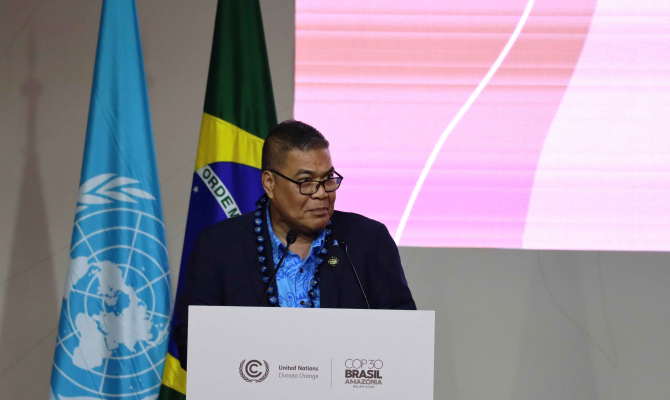
“Across our islands and across the world, we are united in grief, and in purpose,” Micronesia’s Permanent Representative to the United Nations, Ambassador Jeem Lippwe told the 30th Conference of the Parties to the UN Framework Convention on Climate Change (UNFCCC).
“We must act with the same sense of collective purpose that we have seen in moments of great challenge — recognising that only together can we safeguard our future.”
Standing tall and speaking boldly to an audience of leaders and delegates during the resumed High-Level Segment of the conference on Tuesday, Ambassador Lippwe expressed condolences to all those around the world who have suffered from the impacts of climate change.

Like all Pacific delegations, the Ambassador and his delegation have had to travel for several days to join leaders, climate change negotiators and officials in Belem, where for the past nine days, they have been negotiating and amplifying national and regional priorities for a resilient Pacific environment.
The backdrop to COP30 in Brazil is frightening. And every country, big or small, has a story to tell.
In Micronesia, entire islands are losing ground to erosion, and crops fail under saltwater intrusion.
Like so many small island states, FSM is already using it’s own scarce domestic resources to cope—because the support promised decades ago by the global community has not arrived at the scale or speed required.
“Every year, island nations, such as ours, come to this forum with a growing list of loss and devastation,” said Ambassador Lippwe.
“We, who have enjoyed life and prosperity in our lands for innumerable generations and who have contributed so little to the problem at hand. We must now raise our children and grandchildren in a world full of fear and uncertainty. The inequity of the climate crisis is not only unfair – it is unconscionable.”
Under the glowing lights of COP30, FSM called on the world’s major emitting nations and industries to front up with the financial assistance required to match the scale of the devastation.
“Finance is the fuel, without it the engine of climate ambition stalls,” said Ambassador Lippwe.
FSM laments the lack of progress, pointing out that the latest round of NDCs does not offer a viable pathway to 1.5°C.
“When we hear claims of ambition while emissions rise, what are small islands to conclude? That our survival is negotiable? That promises to the most vulnerable can be endlessly deferred? This is not just a failure of policy—it is a failure of moral responsibility.”
The Ocean is equally important, COP30 was reminded.
“The Ocean connects us all, and when it changes, everything changes. This year, scientist announced the onset of the first global tipping point -- our warm water coral reefs are now bleaching to skeletons,” Ambassador Lippwe said.
“Reefs are critical ecosystems for islanders that sustain our fisheries, our economy, and our culture. But they are connected to everything on the planet, and the whole world will soon feel this collapse.”
As a Global Methane Pledge Champion, FSM supports the collective goal of reducing methane at least 30 percent below 2020 levels by 2030.
“Fast mitigation of methane is the only realistic way to slow near-term warming. Yet our global response remains fragmented, voluntary, and insufficient,” said Ambassador Lippwe.
“We call on the Brazilian Presidency to play a leadership role in coordinating the many disparate methane initiatives and turning them into a coherent, ambitious, and accountable global effort.
“And we call on all oil and gas–producing countries to do what the science demands: reduce production, eliminate methane leaks, and prioritise immediate cuts in super-pollutant emissions. The tools exist. The solutions are known. There is no excuse for further delay.”
FSM also highlighted the important role of recent advisory opinion of the International Court of Justice stating that states—and by extension, private actors—have legal obligations to prevent and reduce greenhouse gas emissions.
“This means taking stronger actions now, including deep reductions in methane, and deploying every available measure to protect present and future generations.”
In closing, Ambassador Lippwe encouraged COP30 to move forward with conviction, with compassion, and with the unwavering belief that a united world can still change the course of history.
Ambassador Lippwe presented his statement during the High Level Segment of COP30 on 18 November, 2025 in Belem, Brazil.
The 30th Conference of the Parties to the UN Framework Convention on Climate Change (UNFCCC) is taking place from 10-21 November 2025 in Belem, Brazil.
It is being attended by Pacific leaders and their delegations, who are advocating for the survival of Pacific communities who continue to be at the forefront of climate change impacts.
Support for our Pacific Islands at COP30 from members of the Council of Regional Organisations of the Pacific (CROP) is through the One CROP mechanism led by the Secretariat of the Pacific Regional Environment Programme.
Members of one CROP include: The Secretariat of the Pacific Regional Environment Programme (SPREP) – Lead, Pacific Islands Development Program, Pacific Islands Forum Fisheries Agency, Pacific Island Forum Secretariat, Pacific Community.
A key part of amplifying the One Pacific Voice at COP30 is the Moana Blue Pacific Pavilion and the Pacific Delegation Office. The Moana Blue Pacific Pavilion at COP30 is a Pacific partnership with the Governments of Australia and New Zealand managed by the Secretariat of the Pacific Regional Environment Programme (SPREP).
The Pacific Delegation Office at COP30 is a Pacific partnership with the New Zealand Government managed by the Secretariat of the Pacific Regional Environment Programme (SPREP).
To learn more about the Pacific at COP30 please visit: https://www.sprep.org/cop30