

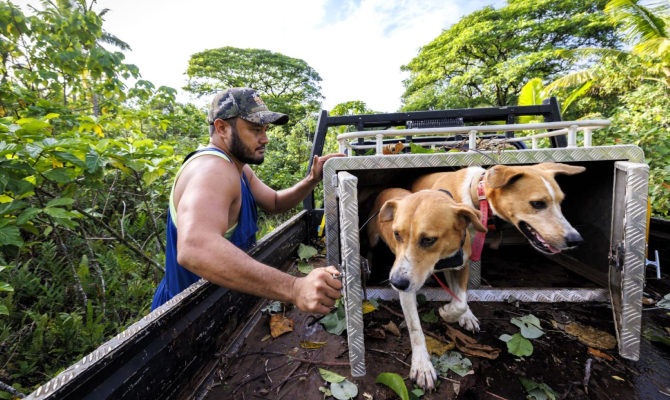
8 December 2025, Alofi, Niue - The Niue Department of Environment has further enhanced its long-term, locally sustained system for controlling feral pigs. The initiative combines the supply of specially bred and trained finder dogs with intensive training and equipping of local hunters, and the creation of an ongoing dog-breeding programme to ensure sustainability.
Niue’s gardens, forests and the culturally treasured uga (land crab) have long suffered from roaming and feral pigs that uproot seedlings, damage crops and degrade soil and coastal ecosystems. Feral and wandering domestic pigs cause significant environmental and economic harm, threatening seedling regeneration, soil health and food security across the island.
Over time, a range of control methods have been trailed in Niue, including snares, lured enclosures, toxins in bait stations and conventional hunting. Many of these methods have proven ineffective at scale or culturally unsustainable.
The Secretariat of the Pacific Regional Environment Programme (SPREP) Centre of Excellence, the Pacific Region Invasive Species Management Support Services (PRISMSS) has long supported Niue’s ambition to control invasive species nationally through the PRISMSS Resilient Ecosystems-Resilient Communities (RERC) programme, including targeted efforts to reduce pig impacts as part of the broader support from the GEF 6 Regional Invasives Project (RIP) initiative.
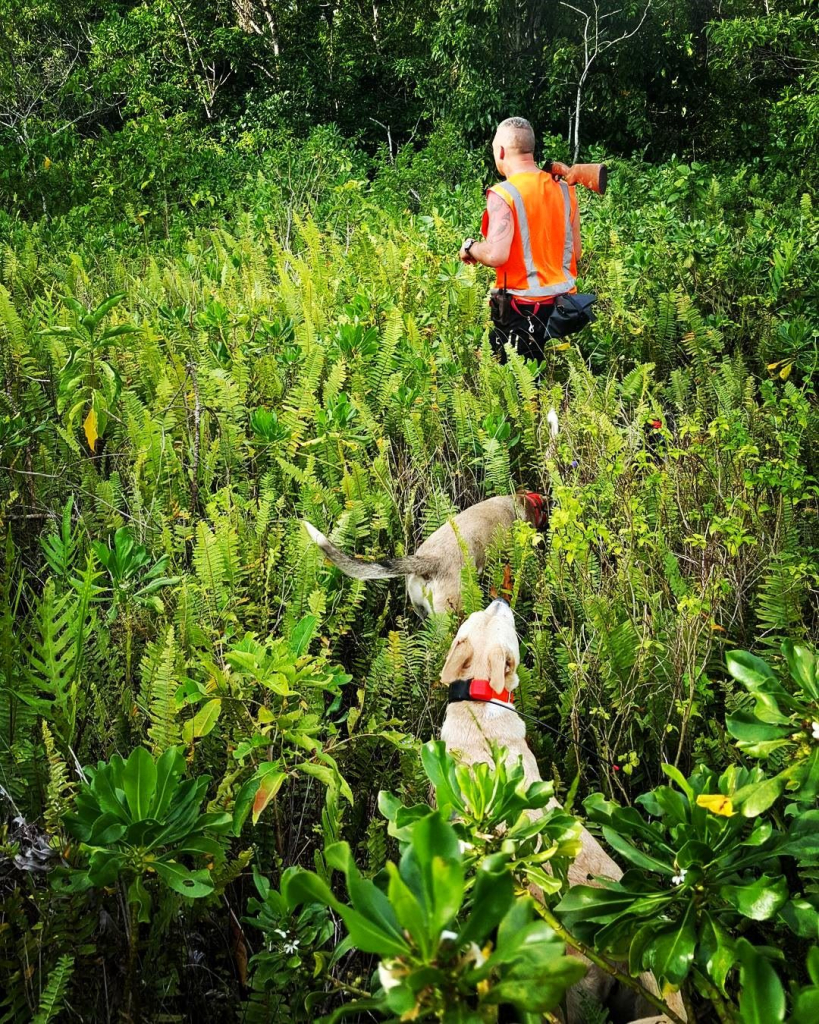
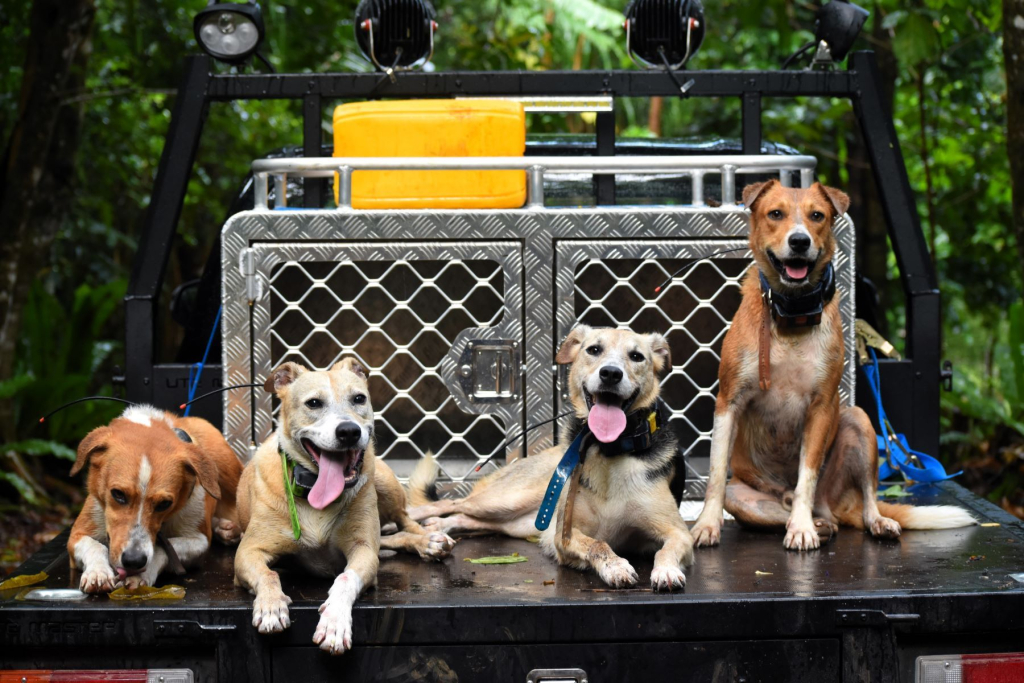
In mid-November a focused programme delivered by Koru Biosecurity Management in partnership with Niue Biosecurity and the Department of Environment, enabled by GEF 6 RIP, with a community led, technology driven approach for sustained pig management, supplied three specially bred and trained GPS collared dogs to Niue and handed over GPS collars and a handheld unit to the Niue Department of Environment.
The dogs arrived fully certified and acclimatised, then joined local kennels to begin hunting and a planned breeding programme. Complementing the canine supply, a six-day intensive training course was delivered to 17 local hunters, blending classroom instruction with practical field sessions that addressed the correct use of finder dogs, GPS tracking equipment, firearms safety and humane dispatch techniques, dog care and breeding and husbandry practices to maintain genetic and behavioural standards.
Field trials on Niue evaluated intensive hunting with GPS tracking, specialist finder dogs, and community acceptability, showing that combining local hunting knowledge with tracking tech can be effective and well received.
Mr. Huggard Tongatule, Niue’s National Invasive Species Coordinator with the Department of Environment, reflected that “the expected community and ecological benefits are multiple and interconnected, including reduced damage to crops and gardens, and improved protection and recovery of uga populations and other native species.
“It will also strengthen food security through the recovery and use of undamaged carcasses, while supporting a locally owned and culturally appropriate control method that can be sustained over time. All pig carcasses are premium-quality, free-range pork, and the meat is shared back with the community as part of the programme’s benefits.”
SPREP Project Manager for GEF 6 RIP, Ms Isabell Rasch-Mulitalo reaffirmed that, “by combining specialist dogs, targeted training, and a locally managed breeding programme, this initiative offers Niue a practical, culturally sensitive and sustainable pathway to reduce feral pig impacts.”
“The approach builds on proven methods, prioritises community involvement and creates the institutional and biological capacity needed for long-term invasive species control combining traditional hunting practices with modern GPS tracking to improve efficiency and community acceptance.”
GPS collared, trained dogs are proving to be a practical and culturally appropriate cornerstone of Niue’s long‑term feral pig management as the collars allow to quickly recover bailed pigs, so carcasses remain intact and dogs are kept safe.
Trained dogs fitted with GPS units allow handlers to monitor movements in real time, locate pigs quickly in dense vegetation, and coordinate teams more safely and efficiently. These specialist dogs are trained to detect and indicate pig presence rather than to hold or attack, which reduces non target impacts and aligns with local hunting customs.
The method builds on Niue’s existing hunting culture, using local hunters and dogs so interventions are culturally appropriate and more likely to be sustained. This technique reduces manpower resource and physical strain, making hunting more accessible for older community members and recovered meat supports households, lowering the incentive to release piglets back into the wild.
Supported by the GEF 6 RIP and PRISMSS, Niue has piloted and scaled this approach as part of ambitious national control targets, demonstrating an effective, community-centred tool for sustainable pig control.
The breeding programme and local operations will now continue under Niue stewardship. Ongoing monitoring and adaptive management have been embedded into the plan to ensure the approach remains effective, culturally appropriate and responsive to changing conditions, with the goal of embedding a durable, community-led capability that reduces feral pig impacts while supporting food security, biodiversity and cultural values.
---------------------------------------------------------------------------------------------------------------------------------------------------
TheGEF 6 Regional Invasives Project (RIP) is funded by the Global Environment Facility, implemented by the United Nations Environment Programme, and executed by the Secretariat of the Pacific Regional Environment Programme. The Project works primarily in the Marshall Islands, Niue, Tonga, and Tuvalu and has a regional component. Implementation of the GEF 6 RIP is supported by the Pacific Regional Invasive Species Management Support Services (PRISMSS). For more information on the GEF6 RIP, please contact the Project Manager Ms Isabell Rasch-Mulitalo, at isabellr@sprep.org
About PRISMSS:The Pacific Regional Invasive Species Management Support Service (PRISMSS) is a coordinating mechanism designed to facilitate the scaling up of operational management of invasive species in the Pacific. PRISMSS, which is led by the Secretariat of the Pacific Regional Environment Programme (SPREP) brings together experts to provide support within the Pacific region with a focus on protection of indigenous biodiversity and ecosystem function. As a service provider, PRISMSS provides a comprehensive suite of support services in a cohesive, effective, efficient, and accessible manner to Pacific Island countries and territories.
Restoring Island Resilience (RIR): The PRISMSS - Restoring Island Resilience (RIR) is a New Zealand-PRISMSS collaboration project that aims to improve Pacific Island Countries and territories livelihoods and resilience to climate change by reducing the impact of invasive species on natural and agricultural ecosystems through the six PRISMSS programmes.
PRISMSS Powered by: New Zealand Foreign Affairs & Trade, UK International Development, GEF, United Nations Environment Programme & SPREP.
PRISMSS Partners: Bioeconomy Science Institute, Birdlife International, Earth Sciences New Zealand, New Zealand Department of Conservation, Island Conservation, the Pacific Community and SPREP.
PRISMSS Programmes: Protect Our Islands (POI), Protect Our Islands (POI), War On Weeds (WOWs), Natural Enemies Natural Solutions (NENS), Resilient Ecosystems Resilient Communities (RERC) and Protect Our Marine Areas (POMA).
For additional information please contact Mr Dominic Sadler, PRISMSS Manager on dominics@sprep.org or Mr Nitish Narayan, PRISMSS Communications & Liaison Officer on nitishn@sprep.org