

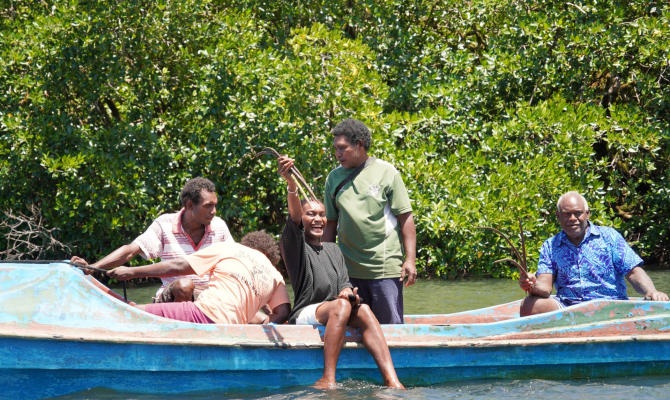
18 December 2025, Malaita Province – Across South Malaita, rising seas, stronger waves, and saltwater intrusion are reshaping coastlines and threatening the foundations of local livelihoods. Mangrove forests, once thick, resilient buffers, have been degraded over decades due to clearing, development pressures, and climate change. As they disappear, shorelines erode, food sources slowly decline, and families lose the natural protection that once stood between them and the expanding ocean.
Communities in Eliote and Ori Ore have already seen the consequences. Mud crabs, mud shells, and fish have moved farther offshore. Taro gardens and low-lying land have been swallowed by saltwater. And the tides, elders say, “are not normal as before.” These environmental shifts underscore a growing urgency that ecosystems must be restored.
The newly launched Ecosystem and Socio-economic Resilience Analysis and Mapping (ESRAM) report under the Pacific Ecosystem-based Adaptation to Climate Change (PEBACC+) project, charts environmental pressures, climate risk, and adaptation priorities for three communities, Eliote, Ori Ore, and Tapa’atewa, with a strong focus on ecosystem-based adaptation as a pathway to protect lives, livelihoods, and landscapes in the face of climate change.
SPREP Biodiversity Conservation and Fiji Office Director, Amena Yauvoli, welcomed the launch of the ESRAM report, emphasising its importance for locally led climate action across the Pacific.
He said, “The ESRAM report is a powerful example of how science, traditional knowledge, and community leadership can come together to drive meaningful climate action. In South Malaita, we see communities not only experiencing the impacts of climate change firsthand, but also leading solutions that restore ecosystems, protect livelihoods, and strengthen resilience for future generations.”
He added, “Ecosystem-based adaptation is not an abstract concept, it is a practical, cost-effective approach that works because it builds on what communities already know and value. SPREP is delighted to support countries and communities to turn evidence like the ESRAM findings into action that safeguards both people and nature across the Pacific.”
Developed through on-the-ground assessments and community consultations, the report helps South Malaita by identifying priority ecosystems such as mangroves that offer the greatest protection and livelihood benefits, mapping climate risks, including erosion, sea-level rise, and saltwater intrusion and evaluating ecosystem services, showing how mangroves support fisheries, food security, coastal defence, and household income.
It also proposes solutions, including mangrove restoration, monitoring, and nursery development and strengthens community-led decision-making through shared knowledge, local stories, and practical recommendations.
For communities already planting, harvesting, and protecting mangroves, the ESRAM report gives confidence, validation, and direction ensuring their efforts align with long-term resilience goals.
.png)
Community Voices from Eliote Village
For Susan Wore, a mother of five from Eliote, mangroves are not just trees, they are her community’s first line of defence. She said, “We’ve planted the mangrove seedlings, but they have been slow in growing… We see the benefits of mangroves because they protect our shorelines from strong waves. Without the mangroves, we’ve seen fish especially mud crabs and mud shells go far away from our shores.”
Her community has planted around 40 seedlings and is experimenting with smaller seedlings that better survive tidal conditions. These practices strengthen one of the ESRAM report’s top priorities: restoring degraded coastal land through mangrove replanting.
Susan showed a technique adapted from Fiji. She added, “We are planting the mangrove seedlings diagonally upwards… When we plant straight up, it does not survive. We chose this site to restore degraded land affected by saltwater intrusion.”
The mangroves are helping prevent further erosion and protect cassava gardens, aligning directly with the report’s call for ecosystem-based adaptation.
Eighty-two-year-old Angel Ita planted his first mangroves in 2024 for a simple reason: food. He said, “We eat the mangrove fruits… There is a local market in Honiara. The market will grow bigger… Mangrove fruit is high in protein just like fish.”
For him, the new ESRAM report is “one hundred percent good,” supporting his desire to learn more about the species that sustain his household.
Cathy Kafena, who married into Eliote from Langalanga, depends on mangroves for income. She said, “We use the new shoot to feed the bees that make honey… We sell it for SBD 120 a bottle in Honiara. That’s income that supports our family.”
Her story reflects a key point in the ESRAM findings that mangroves contribute directly to economic resilience, especially for women.
.png)
Experience from Ori Ore Village
In nearby Ori Ore, community members are trialling bamboo-based mangrove nurseries, reducing plastic use and improving seedling health. Teresa, who helps in the nursery, explains, “The goal is to help the mangroves grow healthier and stronger before planting. This method helps the survival of mangroves in the nursery.”
Young people like Mary Joseph Paire, 22, are learning for the first time how to cultivate and care for mangroves. She said, “Mangrove is a natural resource that naturally grows by itself, but we are also trying to grow other mangrove species in the nursery… We plant mangroves to bring back our mud crabs and mud shells… we sell the mud crabs which is our source of income.”
Her reflections show how the ESRAM report will empower the next generation. She said, “The report will help me in many ways… especially when it’s my first time to plant mangroves.”
For community leader Everisto Kainihau, mangrove restoration is strengthening more than coastlines. He said, “We have witnessed the tides are not normal as before so we have created a barrier to protect our land… We started planting mangroves with the PEBACC+ project that also included training… Before we had no idea how to plant mangroves. It gives the community a lot of benefits like working together and learning the skills.”
He believes the ESRAM report will help guide collaboration with outside organisations and provide communities with greater confidence and direction.
.png)
Scientific Support for Local Action
Ministry of Forestry Botanist, Myknee Sirikolo highlights how combining scientific methods with community leadership boosts survival rates. He said, “Because of the demand for houses and firewood, mangroves have been cut down… Under the PEBACC+ project, we ran a workshop where we trained people about the mangroves… We did direct planting and also nursery methods.”
He notes that nursery-grown seedlings show higher survival rates, underscoring the importance of combining traditional knowledge with ecosystem science, a key theme in the ESRAM findings.
With 600 seedlings already started across Eliote and Ori Ore, he also emphasises the importance of understanding the details of the ESRAM report. He added, “The more knowledge they acquire from the report, that will guide them in caring for the environment… and focus on sustainability and conservation.”
The ESRAM report provides clarity, evidence, and a roadmap for restoring coastal ecosystems, strengthening livelihoods, and preparing for the realities of climate change.
By combining scientific research with the lived experiences of people like Susan, Mary Joseph, Angel, Caty, Everisto, and others, South Malaita is building a future in which mangroves, coastlines, and communities thrive together.
The ESRAM Report was developed by Griffith University under the PEBACC+ Project. The project is being implemented by SPREP and funded by the Kiwa Initiative through its donors, the European Union, Agence Française de Développement (AFD), Global Affairs Canada, Australian Government Department of Foreign Affairs and Trade (DFAT) and New Zealand Ministry of Foreign Affairs and Trade (MFAT), with co-financing from French Facility for Global Environment (FFEM). The project aims to develop, sustain, and institutionalize EbA approaches in Fiji, New Caledonia, Wallis and Futuna, Solomon Islands, and Vanuatu. These efforts will strengthen the resilience of ecosystems, local economies, and communities against the impacts of climate change.
View the ESRAM Report here: https://library.sprep.org/content/ecosystem-and-socio-economic-resilience-analysis-and-mapping-esram-south-malaita-maramasike
For more information, please contact: Setaita Tavanabola, Communications Officer, PEBACC+ Project, SPREP; email: setaitat@sprep.org or visit www.sprep.org/pebacc-plus