


25 February 2026, Apia, Samoa — When Ju Eun Lee's graduation ceremony was held in Korea earlier this week, she was nowhere near the auditorium. She was in Apia, doing the work her degree had trained her for. So her colleagues at the Secretariat of the Pacific Regional Environment Programme (SPREP) made sure she did not miss out by organising a Pacific-style graduation celebration that left the young Korean scientist in tears.
Ju Eun, who has been completing an internship with SPREP's Climate Science and Information (CSI) Programme under an ongoing arrangement with the Korean Meteorological Institute (KMI), graduated this week with a Bachelor of Science in Atmospheric Sciences and AI Convergence from Yonsei University in Korea. Unable to travel home for the ceremony, she received the news surrounded by colleagues who marked the occasion the Pacific way — with warmth, colour, and ceremony that needed no auditorium to feel official.
SPREP Director General Sefanaia Nawadra said the celebration was a reflection of the values of both organisations and the importance of investing in the next generation of climate scientists.
"Climate science is one of the most powerful tools we have to protect the lives and livelihoods of Pacific peoples, and it is only as strong as the people who dedicate themselves to it," Mr Nawadra said. "When a young woman completes a degree in atmospheric sciences and chooses to leave home in South Korea, to sit with our communities, understand our challenges, and contribute to the work that keeps our people safe - that deserves to be celebrated. Ju Eun's achievement reminds us that the solutions to the climate crisis will come from every corner of the world, and that women must be at the forefront of that effort."
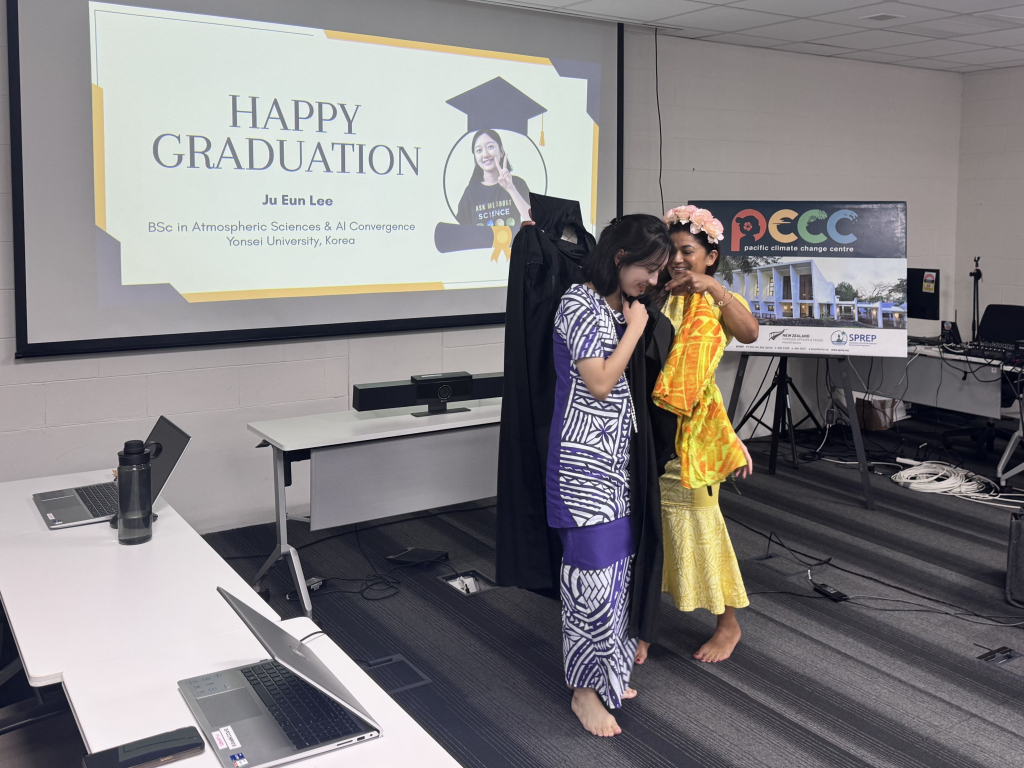
The moment offered a glimpse into a partnership that is quietly making a significant contribution to how climate science is delivered across the Pacific. Under the arrangement between SPREP and KMI, early-career scientists from Korea are embedded within the CSI Programme, working alongside regional climate experts on the data, analysis, and knowledge translation work that supports 15 Pacific Island countries in preparing for and responding to a changing climate. For the interns, it is hands-on experience in one of the world's most climate-vulnerable regions. For the Pacific, it is an injection of technical capacity at a time when demand for skilled climate scientists far exceeds supply.
Ju Eun's specialisation in AI Convergence reflects how rapidly the field of atmospheric science is evolving. Artificial intelligence is increasingly central to how meteorologists model seasonal outlooks, detect extreme weather events, and translate complex climate data into information that governments, farmers, and fishing communities can act upon. Her time at SPREP has grounded that expertise in the real-world context of small island developing states, where a seasonal forecast can determine whether a community plants or waits, whether a fisherman goes out or stays ashore, and whether early warnings reach people in time to make a difference.
The CSI Programme's work spans seasonal climate outlooks, early warning systems, and the long-term strengthening of National Meteorological and Hydrological Services across the region. It operates under SPREP's broader ClimSA Programme, funded by the European Union, which supports climate services across Melanesia, Polynesia, and Micronesia. The partnership with KMI forms part of a wider strategy to build the human and technical capital needed to sustain these services well into the future.
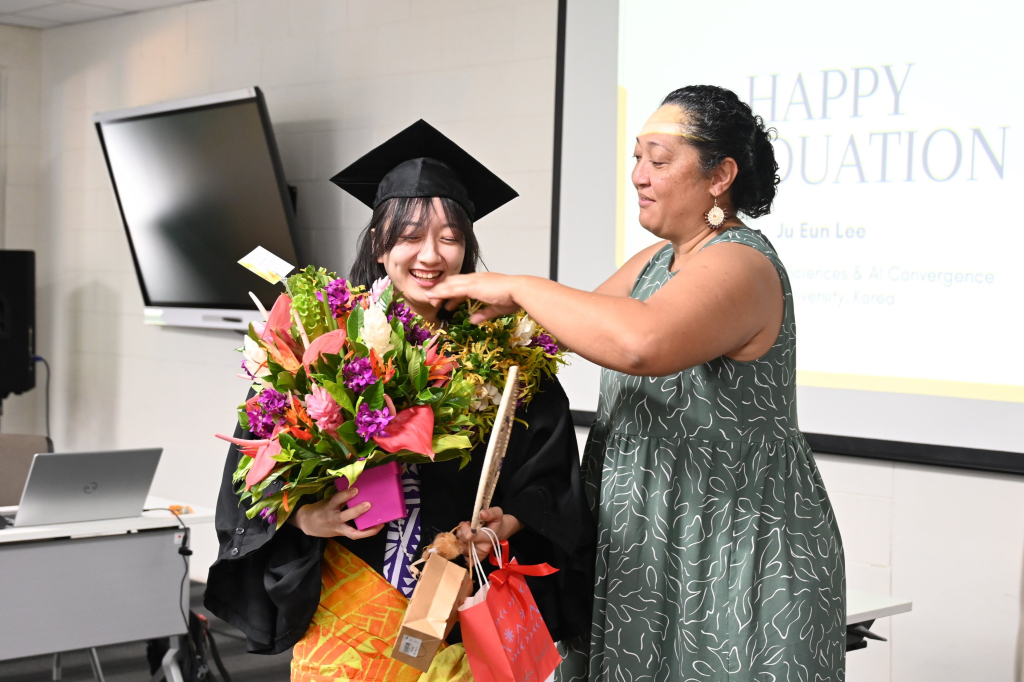
For Ju Eun, the internship has offered something that no classroom could replicate, giving her the understanding that atmospheric science in the Pacific is never abstract. The people whose lives depend on accurate climate information are never far from the conversation, and the responsibility that comes with the work is something she has experienced directly.
That understanding and the kindness of a Pacific graduation far from home, is what moved her to tears as her colleagues gathered to mark her achievement. She had spent years studying the science of the atmosphere. She had come to the Pacific and felt, in the most immediate sense, what that science is truly for.
As the CSI Programme looks to deepen its collaboration with KMI in the years ahead, Ju Eun Lee's story stands as a reminder of what genuine international partnership looks like in practice, not simply institutional agreements on paper, but people from different parts of the world choosing to learn from one another, investing in shared solutions, and taking the time to celebrate each other along the way.
About ClimSA Pacific:
The Climate Services and Related Applications (ClimSA) Programme in the Pacific is a transformative initiative funded by the European Union and implemented by SPREP in partnership with the ACP Secretariat. ClimSA Pacific aims to strengthen climate information services, enhance early warning systems, and empower decision-making across key sectors through tailored, actionable climate products. By supporting National Meteorological and Hydrological Services (NMHSs) and regional coordination, ClimSA Pacific is building a more resilient and climate-informed Pacific community.